A Researcher at Rapid 7 has found a Critical Vulnerability in Google's Play Store Website, leveraging upon which, with the use of Cross-Site Scripting (XSS) in a particular area of website, or a Universal XSS (UXSS) targeting affected browsers, an attacker can perform Remote Code Execution attack, by remotely installing a malicious Android Package (APK). This is due to lack of complete coverage for X-Frame-Options (XFO) support on Google's Play Store web application domain.
According to the report, Android 4.3 (Jelly Bean) users and earlier shipped with browsers having UXSS vulnerabilities, are affected directly by this vulnerability.
Technical Details
Demonstration of XFO Gap
The following Javascript is sufficient to elicit a response from the play.google.com domain without an appropriate XFO header:
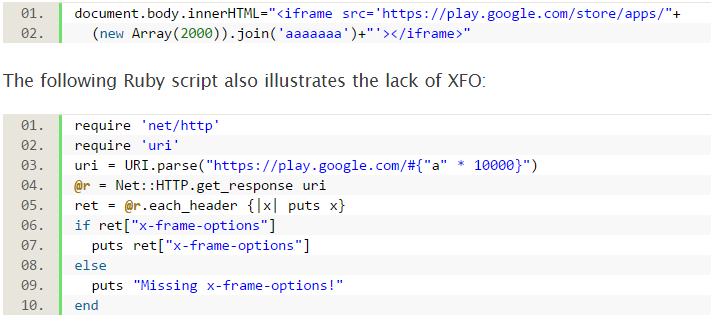
Metasploit module description
The Metasploit module combines two vulnerabilities to achieve remote code execution on affected Android devices. First, the module exploits a Universal Cross-Site Scripting (UXSS) vulnerability present in versions of Android's open source stock browser (the AOSP Browser) as well as some other browsers, prior to 4.4 (KitKat). Second, the Google Play store's web interface fails to enforce a X-Frame-Options: DENY header on some error pages, and therefore, can be targeted for script injection. As a result, this leads to remote code execution through Google Play's remote installation feature, as any application available on the Google Play store can be installed and launched on the user's device.
Mitigation
- Use browser which is not susceptible to widely known UXSS vulnerabilities e.g. Google Chrome, Mozilla Firefox or the Dolphin Browser.
- Don't be logged into a Google Account while using any browser